







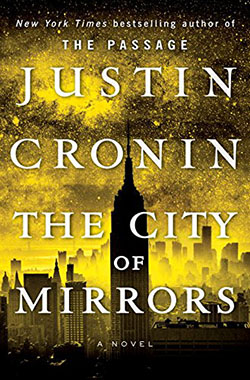
The epic journey that began in The Passage finally comes full circle in The City of Mirrors, a proper doorstopper of a novel that satisfies somewhat in spite of its sheer size and a hell of a hammy bad guy.
I have such fond memories of the beginning of this trilogy, which paired an awesome and expansive apocalypse—one up there, in my estimation, with the end of the world in Swan Song and The Stand—with a truly heartbreaking tale of loss on the small scale. By the denouement of that book, I had no idea where the story as a whole was going to go, but I knew that I wanted to know. And then… well.
The Twelve wasn’t terrible. It had a couple of a kick-ass action scenes, and some stirring slower moments that allowed Justin Cronin to explore the emotions of his vast cast of characters. But almost every other inch of that many-inched monolith of a novel felt like filler; texture at best and time-wasting at worst. In that respect, The City of Mirrors splits the difference. It doesn’t meander as much as its messy predecessor did, but nor, on the back of such bloat, and with more of its own to add to the tally, can it recapture the magic of The Passage.
“Three years had passed since the liberation of the Homeland” that ended The Twelve, and almost a hundred thousand souls now call the walled city of Kerrville, Texas home. Considering how catastrophic the survivors’ situation seemed until recently, that’s reason enough to be optimistic, never mind the fact that there hasn’t been a single viral sighting since:
The age of the viral was over; humankind was finally on the upswing. A continent stood for the taking, and Kerrville was the place where this new age would begin. So why did it seem so meager to [Peter], so frail? Why, standing on the dam of an otherwise encouraging summer morning, did he feel this inward shiver of misgiving?
Perhaps because Peter—the leader of the resistance that took down the Twelve viral progenitors, and in turn the millions of vampires they had sired—has lost his sense of purpose. Or perhaps because “people had begun to openly talk about moving outside the wall,” and he can’t believe that the threat is actually at an end.
It might be that most of Kerrville’s residents are itching to expand beyond the thick brick boundaries they’ve lived their entire lives behind, but there are others who agree with Peter; others who outright refuse to accept that the dracs are done for:
Something was coming; [he] could feel it. He knew it the same as he knew his own heartbeat, the wind of breath in his chest, the carriage of his bones. The long arc of human history was headed toward the hour of its final test. When this hour would come there was no knowing, but come it surely would, and it would be a time for warriors. For men like Lucius Greer.
 But even the likes of Lucius lose some of their certainty as time wears on without significant incident and the central figures of Cronin’s trilogy get busy living. The silly so-and-sos settle down, marry off, get jobs and make a bunch of babies in what must be the most tedious section of said series—all the while, from the safety of his lair in the subway tunnels of the titular city of mirrors, an evil individual regards Kerrvile and the several settlements that spring up around its periphery with envious eyes, and slowly, and surely, draws his plans against them.
Pardon me for paraphrasing, but the melodrama of H. G. Wells’ text is wholly appropriate given the wilful wickedness of The City of Mirrors‘ villain. He’s called Zero, as in patient zero—the first human to contract the virus that led to the Great Catastrophe—and I’m afraid Cronin’s attempts to give his dark designs depth, to somehow humanise the monster that was once the man Timothy Fanning, only make him more ridiculous.
“Indulge me—memory is my method in all things, and the story has more bearing than you think,” the author appears to plead as dives deep into Fanning’s past as a well-to-do Harvard student who tragically lost the lady he loved and summarily became so frustrated with his lot in life that he decided to lay waste to the whole of the human race:
It was absurd, all of it. What had [Amy] expected? Not this. Not this whirlwind of instantly changeable moods and thoughts. This man before her: there was something almost pathetic about him.
When word of his continued existence eventually reaches the remains of civilisation, Alicia—who’s pretty much been chilling with this pitiful villain since the events of The Twelve—Alicia urges (I kid you not) President Peter to take Zero seriously, declaring that “this is different. Fanning is different. He’s been controlling everything from the start. The only reason we were able to kill the Twelve was because he let us. We’re all pieces on a board to him,” is how she puts it, as if The City of Mirrors‘ tendencies toward the obvious weren’t obvious enough.
I’m sorry to say that Cronin’s handling of his antagonist is so very vapid that it serves to suck a lot of the life out of The City of Mirrors, particularly during the text’s uneventful opening sections. Happily, once Zero is given leave to get on with the business of being evil, and the characters in Kerrville get a whiff of what’s in the wind, everything about the book improves.
Whether this injection of tension and terror is too little, too late will depend, in the end, on your desire to see this series through, and whilst I won’t spoil what follows, rest assured that if you do, the ending—excepting an extended epilogue that makes a overlong novel even longer—is excellent, there’s a seismic set-piece that puts The Twelve‘s explosive showdown to shame, and you can expect something close to closure with respect to the handful of survivors who’re still alive when all is said and done.
And so the saga that started with The Passage ends. Not with a bang, though bangs abound, or even a whimper, though Zero supplies several, but with a feeling of relief: relief that the last act turned out quite a bit better than expected; relief, relatedly, that this is “not merely a tale of suffering and loss, arrogance and death, but also one of hope and rebirth”; but first and foremost, for me at least, relief that this story is over.
The City of Mirrors is available now in the US from Ballantine and publishes June 16th in the UK from Orion.
Niall Alexander is an extra-curricular English teacher who reads and writes about all things weird and wonderful for The Speculative Scotsman, Strange Horizons, and Tor.com. He lives with about a bazillion books, his better half and a certain sleekit wee beastie in the central belt of bonnie Scotland.

I really enjoyed the first book. So much that I recommended it to several of my friends and actually convinced them to read it. Every single one of them didn’t like it. Which I found to be very odd. Anyway, I have the 2nd book on my kindle and plan on reading it because I want to know what happens. Sounds like its a bit of a slog, but I’ll have to soldier through it someday soon.
I read and thoroughly enjoyed The Passage. My experience with The Twelve was much less positive. It felt not just slow and overly complex at times but also as though the author revised some of the events of the first book. A fair amount of The Twelve didn’t work for me at all.
Now I view the finish to the series with considerable trepidation. I certainly want to know what happens and I want to experience the climatic finish. But I have forgotten most of what happened in The Twelve and have no desire to re-read it.
I’m going to have to find a comprehensive summary somewhere.
I’ll have to read it to complete the trilogy, but I did lose interest during The Twelve. Hopefully I get terrible food poisoning like I did with the passage and read it in 2 days of slow recovery.
Spoiler alert for City of Mirrors:
I just finished City of Mirrors and thought it was a good ending to the trilogy. It did drag in parts like when Fanning is telling his story. I did not really care to hear his pitiful excuses to end the human race just because the love of his life died. Also I did not like the happy ending Fanning gets.
Can anyone explain to me where Amy and Carter exist when they are tending the garden and lawn? This really confused me and I could not figure out where this fantasy world existed.
Please reply to my email address:[email protected]
in response to the question about Amy and Carter, they are inside the hull of a derelict but intact ship off the Houston coast. Because the ship is over water, for some reason, Fanning has difficulty finding them. They communicate telepathically and patiently spend their time tending a garden over the years, in an imaginary space that serves to occupy their time patiently over the many years while Michael repairs the ship to take everyone else away.
@@@@@ Remo, I think it was more than just “imagination,” to me it was possibly something like an astral plain where their minds were chilling together.
@@@@@ Peter…Jaxon?
Overall, the series was OK. Without giving away too many spoilers, I wasn’t OK with how some of the characters ended up. I think when you put so much energy into a series, you want everyone to have a proper send off, be it good or bad, and I felt this was lacking. The “epilogue” was long. I felt like I finished the book Monday, and between work and kids i couldn’t finish the remaining ~100 page epilogue until the next day, very weird feeling for me.
I too felt Fanning was a bit over the top. As someone said, they didn’t like he got a happy ending. While it wasn’t fire and brimstone, I don’t know if I’d call it happy when you think about it.
I had a few issues with this long anticipated book. But let me preface by saying that I couldn’t put the book down, and that is credit to Cronin’s ability to tell a story. Thus, the storytelling was not an issue; it was the story.
Spoilers coming:
Let’s look at each individual main character and allow me to tell a tale of incompletions.
Peter: figurehead of the colony survivors, and the main one really. His post-death was absolutely a terrible way to conclude his character. Since he was such a strong character with high integrity, why go out this way? Why make him a vampire. This transformation is basically turning him into a pitiful little dog who has lost his memory and is wondering aimlessly around, except he finds his way each night at Amy’s place. Just an incomplete way to finish him off. And then all of a sudden his vampire life undramatically concludes. Peter gone. In terms of being fulfilled, I felt like I received a baby-spoon full of completeness when I was looking for a medium-rare steak atopped with grilled mushrooms and a loaded baked potato
Alicia: Without being melodramatic this time, let’s just face it. Alicia Donadio wouldn’t have killed herself in a million years. She was the strongest character in the book!! It seemed like a copout to conclude her character in that manner. There were places for her to go. Cronin must have meant to show a message that she truly did not love Michael. If she did, she would have given him closure. How could anyone just watch someone grieving over their own supposed death and not say, “Oh, hey, I’m alive and all. Don’t be sad.”
Michael: Umm, where did he end up? Did he get to see the island? Did he ever find out if they reached an island or got stuck at sea? Why sail North? Incomplete.
Amy: I’ll ask this question, and I want you to answer it. What kind of personality did Amy have in the 3rd book? Was she funny, smart, kind, soft spoken?
She didn’t have one. She was a floater. She offered no real perspective. During the real battle, what did she do? Nothing! She had no powers, she didn’t learn the nifty trick of shape-shifting into a viral as Fanning did. So, her purpose in the 3rd book was perplexing. Like, they waited to let her out of the Chevron Mariner, and when they finally did, I was ready for her to take that 20 year build-up and start kicking ass and taking names. This didn’t happen. She was just a tag along for the rest of the book. She didn’t even have mad skills to shoot a machine gun.
She let Peter get his neck masticated into without doing anything! And we really never even know why Fanning wanted her so bad.
I was just waiting for her to shape-shift and rip everyone to shreds because her love (Peter) was being tampered with. Nope, she just let it happen.
Amy’s reappearance 1000 years later was fine, except I would really like to know a few things. Like, why would Amy haunt a descendant until she kills herself? Also, why make her a bit senile. It was unfulfilling that she never got to know that Logan was a descendant of her. It was actually very sad to see that she spent 1000 years alone with no one to talk to. That would make anyone crazy. I didn’t hate her ending, but it was tainted a bit.
The ending of Peter and the great battle had me feeling physically sick that things transpired the way they did, and I guess that’s why this comment turned into somewhat of a rant. If you’re still reading this, let me know what you think.
Thanks,
Just finished book 3 and I liked it
But can someone tell me what was on the paper pim showed amy ?
***Spoiler Alert***
@@@@@kinghunterx5, I had similar thoughts.
Amy: I felt that her “ocean bath” was going to transform her into something better than Fanning. But it only allowed her to become more human so she wouldn’t kill everyone else. And as I read Fanning slowly moving his jaws toward Peter’s neck, I was expecting Amy to do something, anything! I actually read that short paragraph a few times to ensure I didn’t miss something. Nope,
Fanning: It seemed to me that he wanted Amy because she was “created” by Jonas in an attempt to cure Liv who was already dead. Too little too late. He resented Jonas for trying to cure Liv instead of spending time with her, which was what Fanning wanted to do in the first place, but didn’t have the balls to do.. Killing Amy was a way to pay Jonas back, but dead men feel no emotion so it doesn’t matter.
Peter: He has Amy’s DNA coursing through his veins, albeit after her bath, but somehow it is crappy DNA so he only lives a few years. Bummer. I guess if he died at year 999 then that would’ve had some divine Amy intervention and would’ve seem probable. Probable? Oh yeah, vampires.
I would be in the different boat to the author, in the sense that i liked the passage but thought the 12 improved on it significantly. Far from experiencing any filler i was surprised by how much actually occurred in the book and how much was resolved at the end, its final part was also a lot stronger whereas the passages was a bit up in the air.
Id also be a lot more positive of this one, at first i wasnt sure about the books detour with fanning telling his story but at the end i was behind it and felt it was an interesting choice. The build up to the virals returning was quite tense and had a nice feeling of dread behind it and the scenes following this return was quite exciting.
Am I the only one that found the epilogue hard to swallow? After a millennium and near extinction of the human race, our descendants are doing things like shaking hands and wearing suit jackets and ties???
I found so much of this trilogy thoughtful and inspired – did I miss some larger message about humanity or what?
I am so pissed I spent money on City of Mirrors. After “the twelve” I was seriously considering not buying the third. I should have listened to my gut. I hope Cronin made enough money from these books to hang up his writers hat. The first book was amazing, and spurred many delicious ideas of the post apocalypse. Now, all I feel is cheated.
>I’m sorry to say that Cronin’s handling of his antagonist is so very vapid that it serves to suck a lot of the life out of The City of Mirrors,
I’d significantly disagree with this. I felt the author took an odd choice to devote such a significant chunk of the book and devote it to the antagonists early life, mainly during his college years. But by the end of it though the character felt far more 3 dimensional (more so than the previous villains), his life’s episodes were very nicely written and i found myself feeling a variety of emotions towards him, he basically showed that he had a lot of elements to him and didnt entirely consist of one personalty attribute.
>particularly during the text’s uneventful opening sections.
I felt that the initial chapters did a solid job in laying out how things are for the characters and humanity in general after the events of the last book, the idea of diving into action which i believe the writer here wishes would have been a poor choice.
> as if The City of Mirrors‘ tendencies toward the obvious weren’t obvious enough.
Im not sure what was so obvious about the previous piece, the statement would not have been obvious to either the characters or even the readers of the events which occurred during the twelve, the idea that fanning was ok with the said events wouldnt have been known. Its also odd to say something is obvious whilst earlier in the same paragraph express an occurrence as being surprising.
>excepting an extended epilogue that makes a overlong novel even longer
The epilogue was actually one of my favourite parts of the novel, it was interesting to see the fate of humanity and what type of world came i to being, it was also interesting to see how events which we read about as they were unfolding were perceived by those who had to rely on scraps of information. The final piece was also quite sweet and with the authors declared intention ties up with the very beginning of the story. Overall the main reason why i liked the epilogue was due to the fact that the previous couple hundred or so pages were quite action packed, having a moment to catch your breath and have plenty of time to reflect on the previous events of the trilogy was a good choice, whereas wrapping things up would have felt like being short changed.
>for me at least, relief that this story is over.
For me its a shame to see it go.
Also just to other commentators,
@Bob Hambugesa > The first book was amazing, and spurred many delicious ideas of the post apocalypse.
The other books did this too but in greater detail.
@CaseyR >our descendants are doing things like shaking hands.
Not seeing the issue here with shaking hands. Neckties have also been around for centuries.
@malowski11 yeah me too. I loved the epilogue and how humanity had advanced. Thing is I hated how he finished With Peter, total waste of a character. The guy was the man for all 3 books and he dies basically almost off screen (off page?)
The backstory with Fanning was by far the strongest part of the book, developing his character to a stronger extend than any other in the series and giving a believable look at how he came to end up with Lear. If you found that section slow and poorly written, then I think it says more about your taste in quality than Cronin’s writing ability
I completely agree with Kinghunter! I hated the way they left Peter, like his ending was some sort of afterthought. Worse, I hated how he just let Michael disappear into the sunset. Michael was my favorite character, and he just disappears? Really? I agree, Lish would never have killed herself (come ON). And why did Cronin make Amy senile in the end? Like she didn’t even remember putting those rocks out that spelled “Come to me”? The whole ending just bothered me.